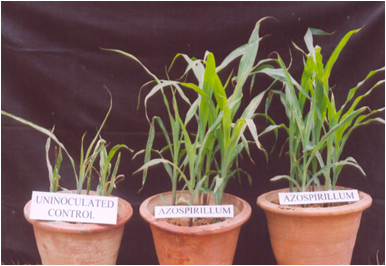
Azospirillum, is an associative nitrogen fixer and occur free-living in soil or in association with the roots of plants.Five species of Azospirillum are A. brasilense, A. lipoferum, A amazonense, A. halopraferens and A. irakense. These inoculants are recommended in non- leguminous crops like jowar, bajra, ragi and other millets( Italian millet, kodo millet, barn yard millet, small millet and oats).
The yield increases due to Azospirillum inoculation recorded are 43% in wheat, 44% in finger millet and 60% in barley. Positive effects of Azospirillum inoculation on growth and yield of several crop plants, mainly cereals is due to the plant growth promoting substances rather than the nitrogen fixing capacity. Increases in grain and fodder yields of millets due to its inoculation are almost equivalent to that attainable with 15-20 kg N /ha.
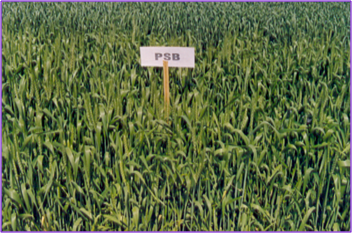
Most of the phosphorus remains fixed in the soil and may not be available to plants. In acidic soils, P is precipitated as Al and Fe phosphates, whereas in calcareous soils, high concentration of Ca results in P precipitation. Phosphate solubilizing biofertilizer (PSB) product depicts a high population of bacteria which can solubilize insoluble phosphates. These are recommended for use in all crops. These have been tested in wheat, paddy, cowpea, soybean, lentil, gram and potato all over India under field conditions.
Increase in the grain yield was in the range of 10-50 % and 40 % of super phosphate could be saved using rockphosphate and phosphomicroorganisms. The standard PSB contains 107 – 108 viable bacterial cells/g of the carrier material which is charcoal (150-212/100 mesh size) neutralized with calcium carbonate.
 Address
 Phone
Phone Enquiry Timings